

BEFORE ANY INVESTIGATION EVEN STARTED....
It's important to understand that from the
very beginning, officials of our government did not want a true investigation
and made every attempt to "make the public satisfied that Oswald was the
assassin."
There may be no other document that makes
it more clear that there was no interest in a true investigation by the highest
federal authorities and it was issued 2 just days after the assassination. A
memo prepared by Walter Jenkins reflects his conversation with J. Edgar Hoover
where
Hoover
makes this telling statement:
"The thing I am most concerned about,
and Mr. Katzenbach, is having something issued so that they can convince the
public that Oswald is the real assassin."
This conversation occurred on November 24,
1963, one day prior to Katzenbach's memo below. Meanwhile,
Hoover
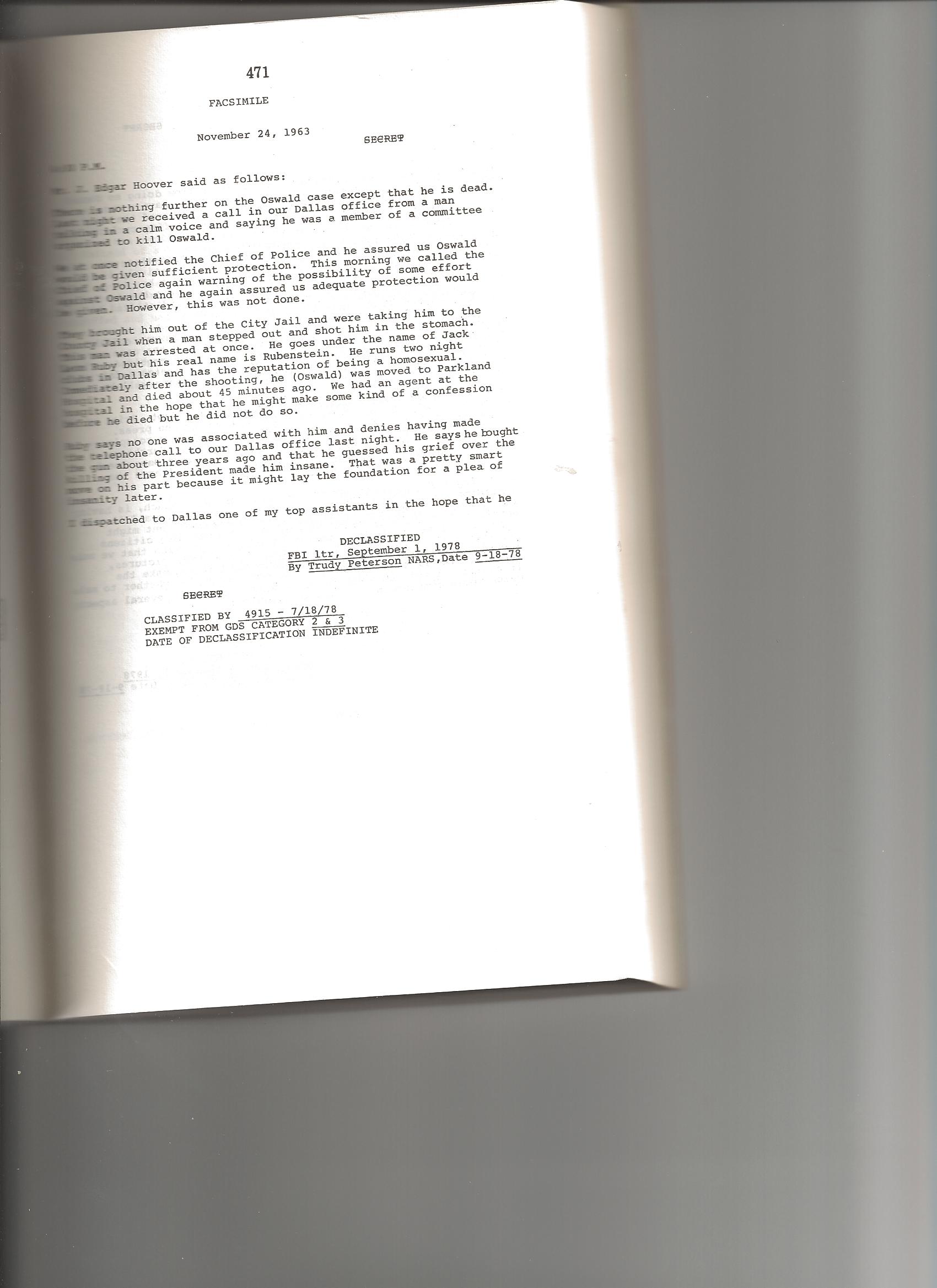
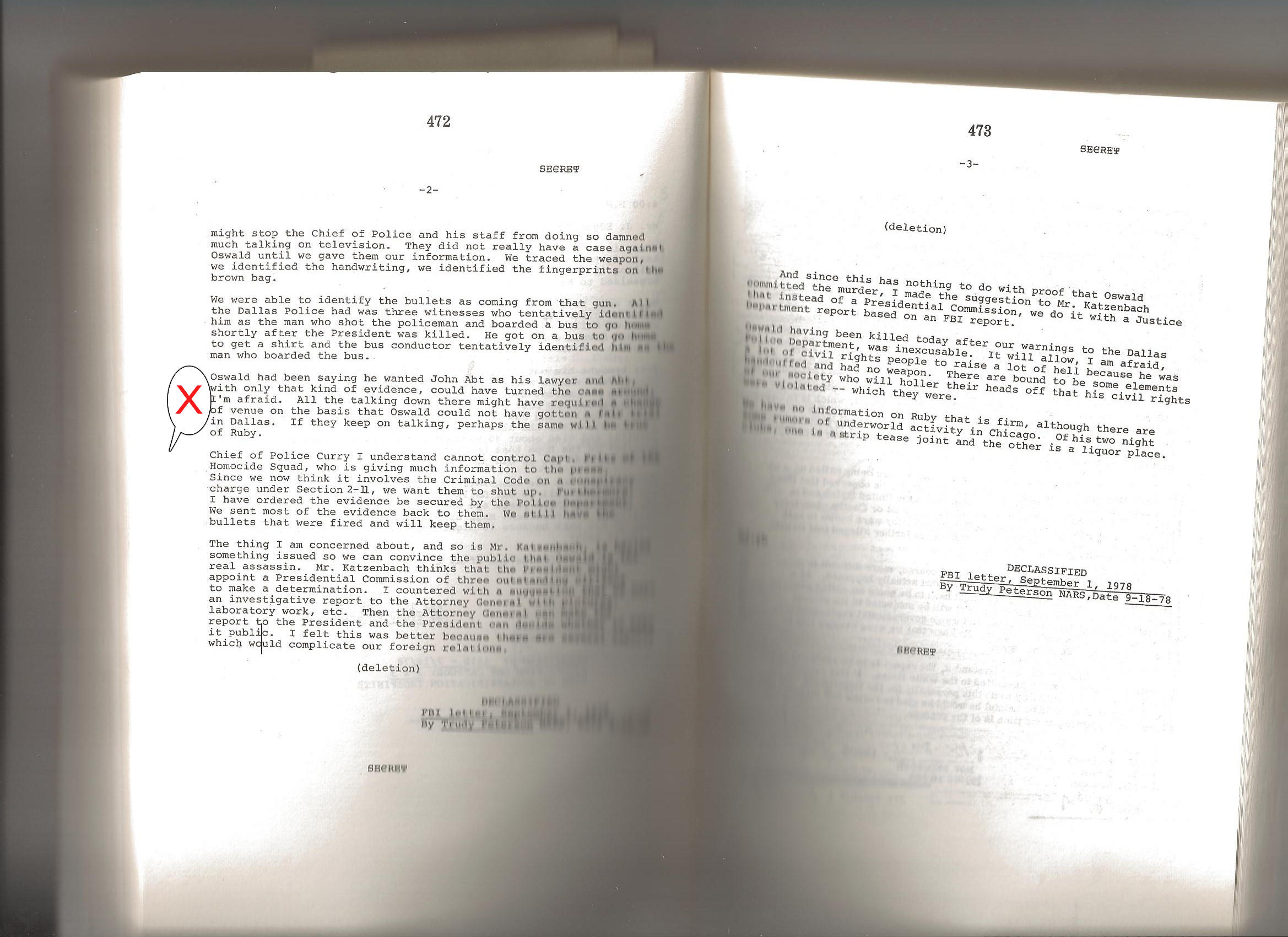
himself wrote a glaring similar memo on the same day that reads:
"The thing I am most concerned about,
and SO IS Mr. Katzenbach, is having something issued so that WE can convince the
pubic that Oswald is the real assassin." (HSCA, Volume 3, pp 471-473. This
memo was apparently prepared by
Hoover
at 4 pm.)
A third memo written by the FBI's Courtney
Evans on November 26th mentions that Hoover himself drafted the Katzenbach memo.
(North, "Act of Treason")
Memo from Nicholas deB. Katzenbach,
Deputy Attorney General
November 25, 1963
MEMORANDUM FOR MR. MOYERS
It is important that all of the facts
surrounding President Kennedy's Assassination be made public in a way which will
satisfy people in the
1. The public must
be satisfied that Oswald was the assassin; that he did not have confederates who
are still at large; and that the evidence was such that he would have been
convicted at trial.
2. Speculation
about Oswald's motivation ought to be cut off, and we should have
some basis for rebutting thought that this was a Communist conspiracy or (as the
Iron Curtain press is saying) a right-wing conspiracy to blame it on the
Communists. Unfortunately the facts on Oswald seem about too pat-- too obvious
(Marxist,
3. The matter has
been handled thus far with neither dignity nor conviction. Facts have
been mixed with rumor and speculation. We can scarcely let the world see us
totally in the image of the
I think this objective may be satisfied by
making public as soon as possible a complete and thorough FBI report on Oswald
and the assassination. This may run into the difficulty of pointing to in-
consistencies between this report and statements by
I think, however, that a statement that all
the facts will be made public property in an orderly and responsible way should
be made now. We need something to head off public
speculation or Congressional hearings of the wrong sort.
Nicholas deB. Katzenbach
Deputy Attorney General
KATZENBACH MEMO
In 1967 it was Illegal for the CIA to operate within U S Territorial Boundries.
Below is what they issued to the News Media on April 1. 1967.
DISPATCH
CLASSIFICATION
PROCESSING ACTION
TOP SECRET
MARKED FOR INDEXING
TO
Chiefs, Certain Stations and Bases
X NO INDEXING REQUIRED
INFO
ONLY
QUALIFIED DESK
CAN JUDGE INDEXING
FROM
The Director of Central Intelligence
MICROFILM
SUBJECT
Countering Criticism of the Warren Report
ACTION REQUIRED
- REFERENCES
PSYCH
1. Our Concern. From
the day of President Kennedy's assassination on,
there has been
speculation about the responsibility for his murder.
Although
this was
stemmed for a time by the
the end of
September 1964), various writers have now had time to scan the
Commission's
published report and documents for new pretexts for questioning,
and there has
been a new wave of books and articles criticizing the Commission's
findings.
In most cases the critics have speculated as to the existence of some
kind of
conspiracy, and often they have implied that the Commission itself was
involved.
Presumably as a result of the increasing challenge to the
Commission's
Report, a public opinion poll recently indicated that 46% of the
American public
did not think that Oswald acted alone, while more than half of
those polled
thought that the Commission had left some questions unresolved.
Doubtless polls
abroad would show similar, or possibly more adverse, results.
2. This trend of opinion is a
matter of concern to the U.S. government,
including our
organization. The members of the
chosen for
their integrity, experience, and prominence.
They represented both
major parties,
and they and their staff were deliberately drawn from all sections
of the country.
Just because of the standing of the Commissioners, efforts to
impugn their
rectitude and wisdom tend to cast doubt on the whole leadership of
American
society. Moreover, there seems to be
an increasing tendency to hint
that President
Johnson himself, as the one person who might be said to have
benefited, was
in some way responsible for the assassination.
Innuendo of
such
seriousness affects not only the individual concerned, but also the whole
reputation of
the American government. Our
organization itself is directly
involved:
among other facts, we contributed information to the investigation.
Conspiracy
theories have frequently thrown suspicion on our organization, for
example by
falsely alleging that Lee Harvey Oswald worked for us.
The aim of
this dispatch
is to provide material for countering and discrediting the claims
of the
conspiracy theorists, so as to inhibit the circulation of such claims in
other
countries. Background information is
supplied in a classified section and
in a number of
unclassified attachments.
3. Action.
We do not recommend that discussion of the assassination ques-
tion be
initiated where it is not already taking place.
Where discussion is
active,
however, addressees are requested:
DISPATCH SYMBOL AND NUMBER DATE
9 attachments
h/w
4/1/67
1 - classified
secret
CLASSIFICATION
HQS FILE NUMBER
8 -
Unclassified
TOP SECRET
DESTROY WHEN NO LONGER
NEEDED
CONTINUATION OF
CLASSIFICATION DISPATCH
SYMBOL AND NUMBER
DISPATCH
TOP SECRET
a.
To discuss the publicity problem with liaison and friendly elite contacts
(especially
politicians and editors), pointing out that the
made as
thorough an investigation as humanly possible, that the charges of the
critics are
without serious foundation, and that further speculative discussion
only plays into
the hands of the opposition. Point
out also that parts of the
conspiracy talk
appear to be deliberately generated by Communist propagandists.
Urge them to
use their influence to discourage unfounded and irresponsible
speculation.
b.
To employ propaganda assets to answer and refute the attacks of the
critics.
Book reviews and feature articles are particularly appropriate for
this purpose.
The unclassified attachments to this guidance should provide
useful
background material for passage to assets. Our
play should point out,
as applicable,
that the critics are (i) wedded to theories adopted before the
evidence was
in, (ii) politically interested, (iii) financially interested, (iv)
hasty and
inaccurate in their research, or (v) infatuated with their own theories.
In the course
of discussions of the whole phenomenon of criticism, a useful
strategy may be
to single out Epstein's theory for attack, using the attached
Fletcher Knebel
article and Spectator piece for background.
(Although Mark
Lane's book is
much less convincing than Epstein's and comes off badly where
contested by
knowledgeable critics, it is also much more difficult to answer
as a whole, as
one becomes lost in a morass of unrelated details.)
4.
In private to media discussions not directed at any particular writer, or
in attacking
publications which may be yet forthcoming, the following arguments
should be
useful:
a.
No significant new evidence has emerged which the Commission did not
consider.
The assassination is sometimes compared (e.g., by Joachim Joesten
and Bertrand
Russell) with the Dreyfus case; however, unlike that case, the
attacks on the
have been
convincingly identified, and there is no agreement among the critics.
(A better
parallel, though an imperfect one, might be with the Reichstag fire
of 1933, which
some competent historians (Fritz Tobias, A.J.P.
now believe was
set by Van der Lubbe on his own initiative, without acting for
either Nazis or
Communists; the Nazis tried to pin the blame on the Communists,
but the latter
have been more successful in convincing the world that the
Nazis were to
blame.)
b.
Critics usually overvalue particular items and ignore others.
They tend
to place more
emphasis on the recollections of individual eyewitnesses (which
are less
reliable and more divergent -- and hence offer more hand-holds for
criticism) and
less on ballistic, autopsy, and photographic evidence.
A close
examination of
the Commission's records will usually show that the conflicting
eyewitness
accounts are quoted out of context, or were discarded by the Commis-
sion for good
and sufficient reason.
c.
Conspiracy on the large scale often suggested would be impossible to con-
ceal in the
royalties, etc.
Note that Robert Kennedy, Attorney General at the time and
John F.
Kennedy's brother, would be the last man to overlook or conceal any
conspiracy.
And as one reviewer pointed out, Congressman Gerald R. Ford would
hardly have
held his tongue for the sake of the Democratic administration, and
Senator Russell
would have had every political interest in exposing any misdeeds
on the part of
Chief Justice Warren. A conspirator
moreover would hardly choose
a location for
a shooting where so much depended on conditions beyond his con-
trol:
the route, the speed of the cars, the moving target, the risk that the
assassin would
be discovered. A group of wealthy
conspirators could have
arranged much
more secure conditions.
d.
Critics have often been enticed by a form of intellectual pride:
they
light on some
theory and fall in love with it; they also scoff at the Commis-
sion because it
did not always answer every question with a flat decision one
way or the
other. Actually, the make-up of the
Commission and its staff was
an excellent
safeguard against over-commitment to any one theory, or against
the illicit
transformation of probabilities into certainties.
CLASSIFICATION
PAGE NO.
FORM
TOP
SECRET
TWO
8-64 53a USE
PREVIOUS EDITION.
X CONTINUED
CONTINUATION OF
CLASSIFICATION DISPATCH
SYMBOL AND NUMBER
DISPATCH
TOP SECRET
e.
Oswald would not have been any sensible person's choice for a co-
conspirator.
He was a "loner," mixed up, of questionable reliability
and an unknown
quantity to any professional intelligence service.
f.
As to charges that the Commission's report was a rush job, it emerged
three months
after the deadline originally set. But
to the degree that
the Commission
tried to speed up its reporting, this was largely due to
the pressure of
irresponsible speculation already appearing, in some cases
coming from the
same critics who, refusing to admit their errors, are now
putting out new
criticism.
g.
Such vague accusations as that "more than ten people have died
mysteri-
ously" can
always be explained in some more natural way:
e.g., the indi-
viduals
concerned have for the most part died of natural causes; the Com-
mission staff
questioned 418 witnesses (the FBI
interviewed far more
people,
conducting 25,000 interviews and reinterviews), and in such a
large group, a
certain number of deaths are to be expected.
(When Penn
Jones, one of
the originators of the "ten mysterious deaths" line, ap-
peared on
television, it emerged that two of the deaths on his list were
from heart
attacks, one from cancer, one was from a head-on collision on
a bridge, and
one occurred when a driver drifted into a bridge abutment.)
5.
Where possible, counter speculation by encouraging reference to the
Commission's
Report itself. Open-minded foreign
readers should still be
impressed by
the care, thoroughness, objectivity and speed with which the Com-
mission worked.
Reviewers of other books might be encouraged to add to their
account the
idea that, checking back with the report itself, they found it far
superior to the
work of its critics.
CLASSIFICATION
PAGE NO.
FORM
TOP SECRET
THREE
8-64 53a USE
PREVIOUS EDITION.
CONTINUED
(40)
Document Number
1035-960
for FOIA Review
on SEP 1976
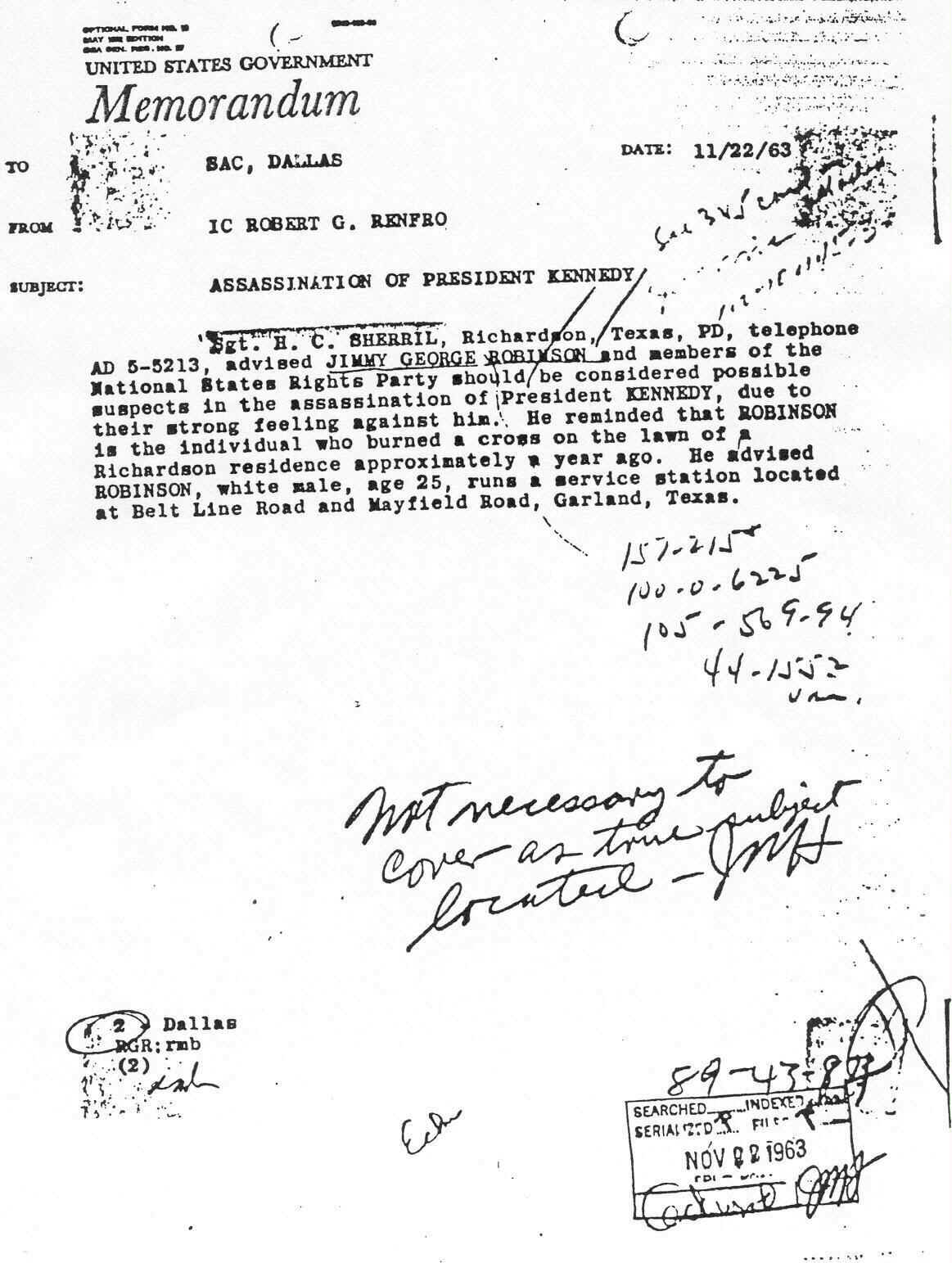
On 11/22/63 Hoover told the Dallas FBI office to NOT look for other suspects.
Contact Information tomnln@cox.net